|

September 4th, 2008, 03:34 PM
|
|
Senior Member
|
|
Join Date: Jul 2006
Location: Alabama
Posts: 297
|
|
Dice pre-sets
Can you shed some light on this?
Explain!
__________________
Counting does not guarantee that you as the counter will always receive the advantagous cards! 
Luck is relative to the amount of hard work and practice we invest. 
Luck is for the unprepared
|

September 5th, 2008, 10:39 AM
|
 |
Executive Member
|
|
Join Date: Dec 2006
Location: PA
Posts: 1,747
|
|
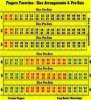
This looks like some sort of a "cheat sheet" card to identify which pre-sets to use. Judging by what is highlighted in red, these are the preferred arrangements...notice how rows #1-3 have combinations of 7 highlighted (for the come-out) and rows #4-6 have box numbers and harways highlighted.
Each of the 6 rows probably corresponds to the 6 sets, and the fraction-looking appearance probably means that the two numbers above the line are the numbers on top of the two dice, while those on the bottom would be on the side facing you.
I'm guessing that this is targeted for players who attempt to toss the dice with little or no bounce...trying to nail an exact combination.
good luck
|

September 5th, 2008, 12:24 PM
|
|
Executive Member
|
|
Join Date: Apr 2008
Posts: 1,902
|
|
Quote:
Originally Posted by ChefJJ
I'm guessing that this is targeted for players who attempt to toss the dice with little or no bounce...trying to nail an exact combination.
|
The numbers could also represent the "side" numbers and an attempt to roll the dice on-axis (such that the side numbers never appear).
|

September 5th, 2008, 12:34 PM
|
 |
Executive Member
|
|
Join Date: Dec 2006
Location: PA
Posts: 1,747
|
|
Quote:
Originally Posted by callipygian
The numbers could also represent the "side" numbers and an attempt to roll the dice on-axis (such that the side numbers never appear).
|
I don't think so...here's why:
Each of the 6 rows are missing a pair of numbers from each combination shown.
Row 1: No 3/4 on the left, no 3/4 on the right.
Row 2: No 2/5 on the left, no 2/5 on the right.
Row 3: No 1/6 on the left, no 1/6 on the right...etc.
The numbers that are missing are actually those that are on the z-axis...the axis one wants to keep the dice rotating around. So the "side" numbers will not be listed on the diagram (even though I've never seen this before in my life).
good luck
|

September 5th, 2008, 04:31 PM
|
|
Executive Member
|
|
Join Date: Apr 2008
Posts: 1,902
|
|
Quote:
Originally Posted by ChefJJ
The numbers that are missing are actually those that are on the z-axis...the axis one wants to keep the dice rotating around.
|
Yeah, I didn't notice the double numbers in the last few rows (which is obviously impossible to be missing side numbers). The numbers above the line could represent the "face up" numbers and the numbers below the line could represent the "facing towards you" numbers on the side when held side by side.
I've never heard of anyone recently try to control dice by sliding them recently, I'm pretty sure they represent something to do with on-axis rolling.
Side note: Is the term "z-axis" typically used to refer to the rolling axis? In mathematics, z is usually used to refer to a vertical, not horizontal, axis.
|

September 5th, 2008, 05:04 PM
|
|
Senior Member
|
|
Join Date: Jul 2006
Location: Alabama
Posts: 297
|
|
Axis = seven
When any die is set, the axis is always a comination of two numbers that will always add up to seven. For example, the 3-V will always have some combination of 1 and 6, or 6 and 1, on one die and 2 and 5, or 5 and 2 on the other die. The first three rows did have some axis combinations that added up to seven. The first row red is actually a 3-V. The second row red could be a 2-V. The third row red could be the 2/3-V.
That is where my reasoning ended, because none of the numbers in black and none of the the numbers in rows 4-6 added up to seven and could not be an axis number.
I still don't understand of what use this would be someone.
__________________
Counting does not guarantee that you as the counter will always receive the advantagous cards! 
Luck is relative to the amount of hard work and practice we invest. 
Luck is for the unprepared
|

September 5th, 2008, 06:41 PM
|
|
Executive Member
|
|
Join Date: Apr 2008
Posts: 1,902
|
|
Quote:
Originally Posted by rdorange
I still don't understand of what use this would be someone. 
|
Well, you could always ask ...
http://crapsbyfingers.com/default.aspx
|

September 5th, 2008, 09:13 PM
|
|
Senior Member
|
|
Join Date: Jul 2006
Location: Alabama
Posts: 297
|
|
Bookmark
Hey JJ, What you said might be. There are combos in the red that only add up to points. Some times the top is a point and the side facing you is a 2 or 12. The sixth row is strange with several 3's and 11's. The part that confuses me is the relationship of the red to black in a single row!
And now, the rest of the story.....
I was at a craps table several years ago. I was just beginning to learn and was practicing setting the dice and (trying) a controlled throw. I had several terrific turns with the dice. My brother was there and was doing similar, by setting and practicing his throw. I feel that I have better sets and better grip, and he has a better throw. Anyway, after we finished and left, we went to eat. On our way out, this (old) man approached us and asked about our throws and where we had learned. He was especially interested in my sets. He gave me this card and said to look for him later at the craps table. He said he wanted to talk more and discuss sets and throws. Needless to say, we didn’t make it back to the tables till the next day, and he was nowhere to be found. So, not being able to make heads or tails of this card, I have been using it as a bookmark for several years. He did a real good job of laminating and it is just the perfect size. The other day while practicing my sets I thought about the card and pulled it out to try and figure it again.
And now you know, the rest of the story….
__________________
Counting does not guarantee that you as the counter will always receive the advantagous cards! 
Luck is relative to the amount of hard work and practice we invest. 
Luck is for the unprepared
|

September 5th, 2008, 09:17 PM
|
|
Senior Member
|
|
Join Date: Jul 2006
Location: Alabama
Posts: 297
|
|
I wish I could "JUST ASK"
Quote:
Originally Posted by callipygian
|
I tried looking him up on the internet several times. Never could find anything. I also tried to find dice arrangements that resembled these patterns, but was never able to find anything close.
__________________
Counting does not guarantee that you as the counter will always receive the advantagous cards! 
Luck is relative to the amount of hard work and practice we invest. 
Luck is for the unprepared
|

September 6th, 2008, 08:01 AM
|
 |
Executive Member
|
|
Join Date: Dec 2006
Location: PA
Posts: 1,747
|
|
Quote:
Originally Posted by callipygian
I've never heard of anyone recently try to control dice by sliding them recently, I'm pretty sure they represent something to do with on-axis rolling.
|
Since sliding is cheating, you are right about that.
I guess I should clarify my separation of "on-axis rolling" and what you might call synch rolling. Synch rolling is where the player throws the dice, trying to keep the numbers on the top of each die together throughout the flight and travel of the dice. Doing so will produce only 4 combinations of numbers...but if one of the two dice "pitches" and rolls an extra quarter-turn, those pre-determined 4 numbers are changed altogether.
What I aim for is the on-axis rolling where all that matters to me is keeping the dice on that pre-set axis. Successfully done, there are 16 rather than 36 possible outcomes of the dice. As you can see from the card, there are 16 entries for each of the 6 rows: 16 combinations for each of the 6 pre-sets.
Therefore, I can almost assure you guys that this card is showing the two top numbers above the line, and the two numbers on the front (facing you). Obviously, as RD pointed out, the opposite side of each die complements and adds up to 7...so the total on the bottom and opposite side of the pair are the same as the top and front, respectively.
In my opinion, keeping the dice from pitching or double-pitching is more difficult than it needs to be. There are 3 pre-sets that are complete junk, leaving 3 more: 1 for the come-out, and 2 for the point-cycle depending on your point. Following that simple method, and by making only the core bets, a player can gain over a 5% advantage in the long run just by keeping the dice on axis about 25-33% of the time.
good luck
|
| Thread Tools |
|
|
| Display Modes |
Linear Mode
|
Posting Rules
|
You may not post new threads
You may not post replies
You may not post attachments
You may not edit your posts
HTML code is Off
|
|
|
All times are GMT -6. The time now is 10:11 AM.
|