QFIT said:
The method used in generating the indexes should be the same as the method used in play.
right thats what my thinking was.
i have this simulator sage-blackjack (no relation). well any way here is some thing from the HELP section with regard to true count computation (to me it's a bit sketchy) that perhaps in my understanding lead me to believe i should truncate deck estimation.
help section pasted below:
Count Definition Dialog Box
The Count Definition dialog box is displayed when the Count Definition button on the Seat Settings dialog box is selected.
This dialog box provides the user with the means to define his own count values for the cards. These values are used to keep a
running count as cards are dealt in order to predict the favorability of the cards yet to be dealt. A player can then adjust his bet
based on this count to take advantage of the favorable conditions.
The information on this dialog box is used when: the playing strategy of this player has some custom actions defined, the betting
strategy of this player is based on the count, an enter condition based on the count is defined for this player, an exit condition
based on the count is defined for this player, an evaluation is being performed on a hand type for this player based on the count,
statistics based on the true count is defined, or when statistics based on count reversal is defined.
The default values in this dialog box define a simple count definition that has been proven to give the player an advantage over the
casino. The low cards (2 through 6) are given a value of 1, the middle range cards (7, 8, and 9) are given a value of 0, and the high
cards (10 and A) are given a value of -1. The running count is calculated by adding the count value of each card to the previous
running count as the cards are being dealt by the dealer. The running count should be reset (usually to 0) each time the cards are
shuffled. For example, if the count values for the cards are the default values stated above and the dealer dealt the following
cards: 2, 8, Q, 3, A, 7, 2, the running count would be: 1 + 0 + -1 + 1 + -1 + 0 + 1 = 1.
The running count gives a general indication of how favorable the remaining cards are. A positive running count means that the
cards are favorable and a negative running count means that the cards are unfavorable. Suppose that the running count was 2.
We know that there are more 10-valued cards and aces in relation to other cards than in a new deck. But if only 2 cards have
been dealt, there is still a very good chance that the next card will not be either an ace or a 10. Now suppose that only 2 cards
remain to be dealt. We are guaranteed that each of the 2 remaining cards will either be an ace or a 10. That is why in order to get
a better idea of how favorable or unfavorable the cards are we must link the running count to the number of cards remaining. This
is where the true count comes in. The true count is the running count divided by the number of decks remaining. The true count
gives a good representation of the favorability of a deck no matter how many cards remain to be dealt. The larger the true count,
the more favorable the cards are, the smaller the true count, the less favorable the cards are. The true count is what card
counters use to base their bet and their playing strategy on.
The Card Index column represents the card to define the count for. The Count Value fields represent the count value for the
specified card. At the bottom of the dialog box below the Count Value fields is a value that represents the value of the entire deck
when these count values are used. In most cases this value should be 0 to have an effective point count system, however there
are systems that utilize an unbalanced count where the deck value is something other than 0.
The True count adjusted to radio buttons defines the manner in which the true count is calculated from the running count. When
1/2 deck is selected, the true count is calculated by dividing the running count by the number of half decks remaining. For
example, if the running count is 4 and there are 2 decks remaining, the true count is 4 / 4 = 1. When 1 deck is selected the true
count is calculated by dividing the running count by the number of decks remaining. For example, if the running count is 4 and
there are 2 decks remaining, the true count is 4 / 2 = 2. When No adjustment is selected, the true count is equal to the running
count. There are some unbalanced counting systems which do not require adjusting the running count.
The True count calculation radio buttons also effects how the true count is calculated. These buttons represent the deck
interval used to determine the number of remaining decks. If, for example, there are 33 cards remaining to be dealt and the
Nearest 1/8 deck radio button is selected, the number of decks used to calculate the true count will be 5/8 because this is the
closest 1/8 deck that represents 33 cards. If the Nearest 1/2 deck radio button is selected, the number of decks used to
calculate the true count will be 1/2 (26 is closer to 33 than 52 is). The smaller the deck interval used results in a more accurate
true count. Although it is easy for a computer to keep track of the exact number of cards remaining, we humans must make do
with an approximation. Very little advantage is lost by using an approximation as opposed to using the exact number however so
don't feel bad.
The Starting running count field defines the starting running count right after the cards have been shuffled. In most cases this
should be 0. There are some unbalance counting systems which may start at other values. If an unbalanced count is used (for
instance, if the deck value is 4), the value defined here should usually be the negative of the deck value (-4) multiplied by the
number of decks used in the game. In this example when a 6 deck game is used, the starting running count should be -4 * 6 =
-24 and this will be the starting running count used after every shuffle. And if the dealer deals every card out, the running count will
be 0 after the last card is dealt.
Theories
It has been proven that when the cards are rich in 10s and aces, it is favorable to the players because the players get more
blackjacks which usually pays 3 to 2 and the dealer breaks more often than usual. Also it has been proven that when the cards
are rich in small valued cards, it is unfavorable to the players because it is less likely that they get blackjacks and the dealer will
break less than usual.
This doesn't mean that the default count values mentioned above represents the best count definition that exists. Although these
values have been proven to work, there are different systems that produce better results. Usually the better the system, the more
complex it is. Some systems use values greater than 1 and smaller than -1, attempting to give a more precise weight to the
importance of the card. Other systems require side counts of other cards such as aces. Although some of these systems are
much more complicated than the one presented above, they yield only slightly more of an advantage to the player. We are only
human and occasionally make mistakes. Playing a simple strategy perfectly is much better than playing a complicated strategy
imperfectly. With is in mind, choose a system that you are comfortable with. Most book stores have many different systems to
choose from.
end help section
and here is the setting window that applies:

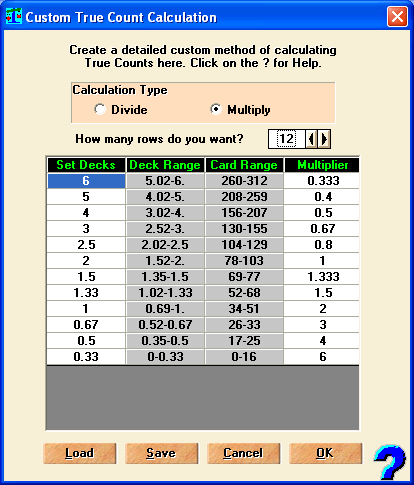
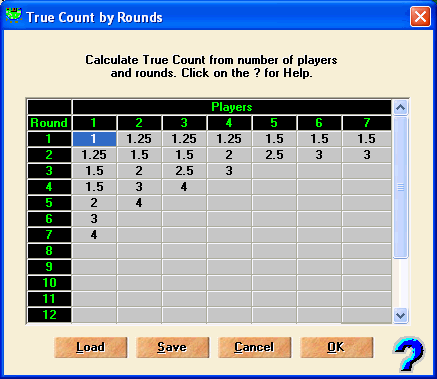
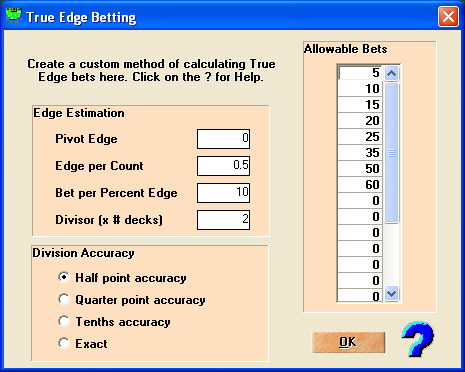
it just seemed to me the wise thing would be to truncate the deck estimation. it's a bit confusing to me how the simulator calculates the true count. it seems dependent upon how you estimate the remaining decks.
best regards,
mr fr0g