

You are using an out of date browser. It may not display this or other websites correctly.
You should upgrade or use an alternative browser.
You should upgrade or use an alternative browser.
Calculating the EV for Steering a Ten to the Dealer's Hand
- Thread starter iCountNTrack
- Start date


Very nice! My only question is how do you come up with the all-important combinatorial analysis results of EV for each hand?

zengrifter
Banned
I used to think that if I knew where the 10 is I would want it. But it turns out the 10
is more valuable IF we can steer it to the dealer first hit. Regardless of dealers up card.
Of course it would look weird not to hit 7-2 just to send the 10 to the dealer. zg
is more valuable IF we can steer it to the dealer first hit. Regardless of dealers up card.
Of course it would look weird not to hit 7-2 just to send the 10 to the dealer. zg
I used to think that if I knew where the 10 is I would want it. But it turns out the 10
is more valuable IF we can steer it to the dealer first hit. Regardless of dealers up card.
Of course it would look weird not to hit 7-2 just to send the 10 to the dealer. zg
That's easy, "you don't want to take the dealer's bust card"
Of course it would look weird not to hit 7-2 just to send the 10 to the dealer. zg
You would only not hit 7-2 if 19 v dealers up card has less EV than knowing the hit card is a 10 with the given dealer up card.
I have a feeling, more often than not, you'd hit (or still double). Of course, if you are steering the card, you are likely playing multiple hands, in which case you'd also have to weigh in the EV effect your play would have on those hands.
I want to clarify the OP. Unless I'm misreading (and I'm about to fall asleep, so it is very possible), the EV figures given are for those cases where the dealer has a hittable hand. So the situation isn't +38% EV off the top, it is +38% IF the dealer has to take a card. Naturally, there is some percentage of the time where the dealer won't have a hittable hand, and more often than not, we lost those times.
I'm really tired, so I'm not going to do the math, but I think it may still be more advantageous to give yourself the 10.
Of course, giving yourself the 10 helps you with 1 hand, if you are playing multiple hands, it still may be better to steer it to the dealer.
BTW, Nice work OP, great thread.
I'm really tired, so I'm not going to do the math, but I think it may still be more advantageous to give yourself the 10.
Of course, giving yourself the 10 helps you with 1 hand, if you are playing multiple hands, it still may be better to steer it to the dealer.
BTW, Nice work OP, great thread.
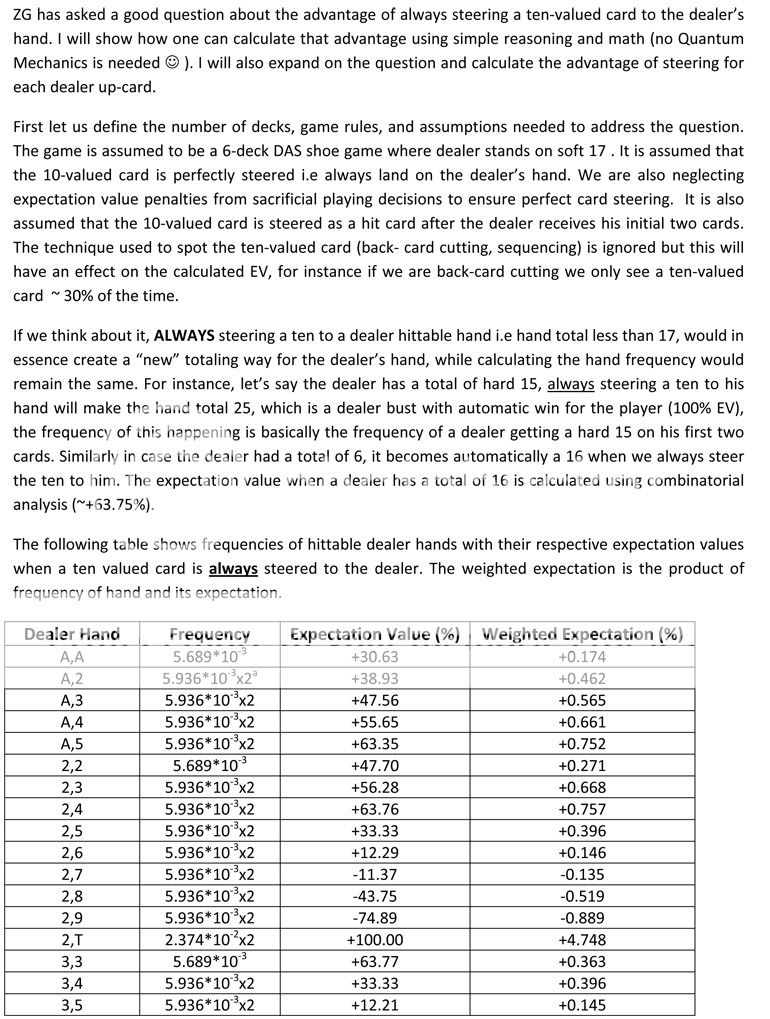
This last chart indicates that if you KNOW that you can steer a 10 to the dealer as a hit card, your AVERAGE advantage is 5.683%.
In a REAL-LIFE situation it will be different than this, depending upon the situation. The accuracy of the game will obviously lower the edge quite significantly. Even with 100% accuracy, there will be times when the card CANNOT be steered to the dealer for one reason or another. There will be times when you will want to use the 10 YOURSELF, in the case of a double down or in splitting aces (This of course will ADD to your edge).
Also, the charts presented by the OP are assuming that the player gets to play basic strategy; and THEN gets to leave the ten.
As an example; suppose you know that the FIFTH card (first hit card) is a ten. If the dealer gets a ten as an upcard, you will take the hit (or double down) if you have 11 or less, or if you have 2 aces. The rest of the time you will obviously be standing on ALL stiffs. According to my simulation program this means that your advantage vs. a ten is only 6.41% rather than 11.87%.
Don't get me wrong - this is extremely useful information for me,and it is great work by the OP - but personally;when I track a ten, I think I'm going to continue to steer it to myself in MOST situations.
My only question is how do you come up with the all-important combinatorial analysis results of EV for each hand?
bump
iCountNTrack
Well-Known Member
This last chart indicates that if you KNOW that you can steer a 10 to the dealer as a hit card, your AVERAGE advantage is 5.683%.
I am not sure i think this is very useful number
 , I should also add that the numbers in the last figures are INCREASE in EV when you steer the 10 to the dealer rather than actual OVERALL EVs. Because for A,7,8,9,T you have to include the EV of pat hands that are not hittable and will not be affected by that steered 10.
In a REAL-LIFE situation it will be different than this, depending upon the situation. The accuracy of the game will obviously lower the edge quite significantly. Even with 100% accuracy, there will be times when the card CANNOT be steered to the dealer for one reason or another. There will be times when you will want to use the 10 YOURSELF, in the case of a double down or in splitting aces (This of course will ADD to your edge).
yep, that is true, i did write something up about that http://www.blackjackinfo.com/bb/showthread.php?p=172003 , but as i have mentioned in the beginning of the post, we are ALWAYS assuming that we perfectly steer the card to the dealer. We also totally ignore HOW we spotted the ten because that will affect EV calculations.
Also, the charts presented by the OP are assuming that the player gets to play basic strategy; and THEN gets to leave the ten.
As an example; suppose you know that the FIFTH card (first hit card) is a ten. If the dealer gets a ten as an upcard, you will take the hit (or double down) if you have 11 or less, or if you have 2 aces. The rest of the time you will obviously be standing on ALL stiffs. According to my simulation program this means that your advantage vs. a ten is only 6.41% rather than 11.87%.
I did say that we are neglecting EV penalties from departures of perfect playing decisions to ensure proper steering (usually a good approximation).
As far as the discrepancy for the advantage vs a dealer's ten you get from your simulator vs the number i calculated, they are not actually that far. The discrepancy is not mostly due to ignoring the loss in EV from sacrificial play but rather to a mis-comparison
As i have mentioned in the above the numbers in the second table represent the INCREASE in EV, what you calculated is the OVERALL EV, to calculate the OVERALL EV in my case, we will need to add the frequency-weighted EVs for pat hands when dealer is showing a ten. We will get 8.52% as OVERALL EV.
If we do the same thing to calculate the OVERALL EV from always steering hands by including all the non-hittable pat hands with their respective frequency weighted EVs we get +31.71% .
iCountNTrack
Well-Known Member
Very nice! My only question is how do you come up with the all-important combinatorial analysis results of EV for each hand?
Combinatorial analysis is basically enumerating all possible outcomes, and calculating the probability for each outcome. This can done using some formulas or using brute force enumeration pencil and paper or coding, for a game like blackjack the best is to do it through coding. Because you have to look all possible outcomes (hands) for dealer and for the player. Splits can make things a royal pain. k_c can probably better explain this.
There is also a good couple of pages about CA in Theory of Blackjack, i think at the end of second chapter.
Better but not perfect solution
Basically I think assume_R was wondering more about the source rather than how to do the computations. Below the first image shows what icnt did using dealer hand of 2-2 and assumption of a ten drawn 100% of the time for dealer's first hit card. The program computes an overall EV for all possible player hands given the knowledge that dealer's cards consist of what is displayed. The problem with this solution is that player wouldn't have that much info. The info that he would have is dealer's up card and that dealer's first hit is a ten. The second image shows the overall EV for this scenario when up card = 2. In order to evaluate the overall EV given dealer's first hit card is a ten you look at each possible up card so dealer's hands would be 2-T, 3-T, 4-T, 5-T, 6-T, 7-?-T, 8-?-T, 9-?-T, T-?-T, A-?-T where the question mark would be replaced with all possible dealer hole cards. When filling in the question mark would result in a pat dealer hand then the EV used would be for a 2 card dealer hand since in that case dealer wouldn't take a hit. However this still wouldn't be a perfect solution because for the hands with the question mark the program would be computing as if player had full knowledge of dealer's hole card, which wouldn't be the case, although hands without a question mark would be accurate for what is actually known.
Whatever the data, each possibility needs to be weighted to reflect its contribution to overall EV, as was done by icnt.
Originally Posted by assume_R
Very nice! My only question is how do you come up with the all-important combinatorial analysis results of EV for each hand?
Originally Posted by iCountNTrack
Combinatorial analysis is basically enumerating all possible outcomes, and calculating the probability for each outcome. This can done using some formulas or using brute force enumeration pencil and paper or coding, for a game like blackjack the best is to do it through coding. Because you have to look all possible outcomes (hands) for dealer and for the player. Splits can make things a royal pain. k_c can probably better explain this.
There is also a good couple of pages about CA in Theory of Blackjack, i think at the end of second chapter.
Basically I think assume_R was wondering more about the source rather than how to do the computations. Below the first image shows what icnt did using dealer hand of 2-2 and assumption of a ten drawn 100% of the time for dealer's first hit card. The program computes an overall EV for all possible player hands given the knowledge that dealer's cards consist of what is displayed. The problem with this solution is that player wouldn't have that much info. The info that he would have is dealer's up card and that dealer's first hit is a ten. The second image shows the overall EV for this scenario when up card = 2. In order to evaluate the overall EV given dealer's first hit card is a ten you look at each possible up card so dealer's hands would be 2-T, 3-T, 4-T, 5-T, 6-T, 7-?-T, 8-?-T, 9-?-T, T-?-T, A-?-T where the question mark would be replaced with all possible dealer hole cards. When filling in the question mark would result in a pat dealer hand then the EV used would be for a 2 card dealer hand since in that case dealer wouldn't take a hit. However this still wouldn't be a perfect solution because for the hands with the question mark the program would be computing as if player had full knowledge of dealer's hole card, which wouldn't be the case, although hands without a question mark would be accurate for what is actually known.
Whatever the data, each possibility needs to be weighted to reflect its contribution to overall EV, as was done by icnt.
Attachments
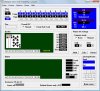
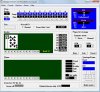
The second image shows the overall EV for this scenario when up card = 2. In order to evaluate the overall EV given dealer's first hit card is a ten you look at each possible up card so dealer's hands would be 2-T, 3-T, 4-T, 5-T, 6-T, 7-?-T, 8-?-T, 9-?-T, T-?-T, A-?-T where the question mark would be replaced with all possible dealer hole cards. When filling in the question mark would result in a pat dealer hand then the EV used would be for a 2 card dealer hand since in that case dealer wouldn't take a hit. However this still wouldn't be a perfect solution because for the hands with the question mark the program would be computing as if player had full knowledge of dealer's hole card, which wouldn't be the case, although hands without a question mark would be accurate for what is actually known.
Okay could you please explain this a bit further? I am unsure why you put 6-T and then 7-?-T. Where is 6-?-T and 7-T (i.e. 3,4,T)? Is it because no matter what the hole card is for the stiff hands (except for the 6 upcard example in H17), the dealer will definitely hit? How does that affect which hands you need the EV for and how to compute it? I think I'm missing something obvious here. Thanks for taking the time to explain.
Okay could you please explain this a bit further? I am unsure why you put 6-T and then 7-?-T. Where is 6-?-T and 7-T (i.e. 3,4,T)? Is it because no matter what the hole card is for the stiff hands (except for the 6 upcard example in H17), the dealer will definitely hit? How does that affect which hands you need the EV for and how to compute it? I think I'm missing something obvious here. Thanks for taking the time to explain.
You are right. I should have included 6-?-T to allow for a possible dealer hand of soft 17, since input rules were dealer stands on soft 17.
Basically the program computes EV for all possible player and dealer hands. If nothing is input for either player or dealer then program computes overall EV for whatever composition is input using total dependent basic strategy. If player or dealer cards are input then program computes EV based upon partial information.
In this case we are only considering added information about dealer. Normally all that is known about dealer is the up card. When dealer draws cards all that matters is the hard or soft total so if up card = 2 and it is known that the first hit card is a ten then it is the same as saying dealer starts out with hard 12. The program then computes all possiblities for a dealer starting out with hard 12. If dealer's up card = 7 and the first hit card is a ten you can't say dealer started out with hard 17. If 7-T was input for dealer the program would compute TD basic strategy EV for playing versus a dealer hand of hard 17, which is not what we want. Therefore unlike the case where up card = 2 all of the possible hole cards need to be itemized individually. As I said this is not a perfect solution because in these cases the program is computing assuming perfect knowledge of all dealer cards when in actuality less is known.
Hope that helps.
In this case we are only considering added information about dealer. Normally all that is known about dealer is the up card. When dealer draws cards all that matters is the hard or soft total so if up card = 2 and it is known that the first hit card is a ten then it is the same as saying dealer starts out with hard 12. The program then computes all possiblities for a dealer starting out with hard 12. If dealer's up card = 7 and the first hit card is a ten you can't say dealer started out with hard 17. If 7-T was input for dealer the program would compute TD basic strategy EV for playing versus a dealer hand of hard 17, which is not what we want. Therefore unlike the case where up card = 2 all of the possible hole cards need to be itemized individually.
Okay, so the idea is it's okay to "pretend" the dealer has a hard 12, but not okay to "pretend" the dealer has a hard 17? What's the difference, and why shouldn't we be doing 2-?-T for all values of "?". For the 7-T example, it's no good because we don't want "TD basic strategy EV for playing versus a dealer hand of hard 17"? I think this is where I'm lost. What's wrong with doing 2-?-T and isn't that what we actually want?
Okay, so the idea is it's okay to "pretend" the dealer has a hard 12, but not okay to "pretend" the dealer has a hard 17? What's the difference, and why shouldn't we be doing 2-?-T for all values of "?". For the 7-T example, it's no good because we don't want "TD basic strategy EV for playing versus a dealer hand of hard 17"? I think this is where I'm lost. What's wrong with doing 2-?-T and isn't that what we actually want?
This is the difference:
If dealer hand is hard 12 the program figures EV based on a player strategy of playing versus hard 12. This is the same as hole card strategy with an up card = 2 and player knowing dealer's hole card is a ten. In the case where the first hit card is a ten player doesn't know dealer's hole card. The hole card can be anything but there is no difference between a dealer hand of 2-(known hole card = T)-(unknown hit card) and 2-(unknown hole card)-(known hit card = T). The 2 situations are mathematically identical and can be input into the program as dealer hand = 2-T.
If dealer up card = 7 and first hit card is a ten, player still doesn't know dealer's hole card. However if we try to treat 7-(known hole card = T)-(unknown hit card) and 7-(unknown hole card)-(known hit card = T) identically by simply inputting dealer hand = 7-T, it won't work. 7-T is a pat hand and the program won't draw to it. We will be ignoring any possiblity of a dealer hand other than 7-T.
It's a matter of using what the software is programmed to do. It's programmed to hit dealer hands < hard 17, hit dealer hands < soft 17 if dealer stands on soft 17, and hit dealer hands < soft 18 if dealer hits soft 17.
This is the difference:
If dealer hand is hard 12 the program figures EV based on a player strategy of playing versus hard 12. This is the same as hole card strategy with an up card = 2 and player knowing dealer's hole card is a ten. In the case where the first hit card is a ten player doesn't know dealer's hole card. The hole card can be anything but there is no difference between a dealer hand of 2-(known hole card = T)-(unknown hit card) and 2-(unknown hole card)-(known hit card = T). The 2 situations are mathematically identical and can be input into the program as dealer hand = 2-T.
If dealer up card = 7 and first hit card is a ten, player still doesn't know dealer's hole card. However if we try to treat 7-(known hole card = T)-(unknown hit card) and 7-(unknown hole card)-(known hit card = T) identically by simply inputting dealer hand = 7-T, it won't work. 7-T is a pat hand and the program won't draw to it. We will be ignoring any possiblity of a dealer hand other than 7-T.
It's a matter of using what the software is programmed to do. It's programmed to hit dealer hands < hard 17, hit dealer hands < soft 17 if dealer stands on soft 17, and hit dealer hands < soft 18 if dealer hits soft 17.
Ohhhh so the idea is that using 7-T, the dealer would stand. And we wouldn't get any 7-?-T output. But for 2-T, the dealer would hit, and that's why it would go through every possible outcome for the hit. I understand. And for 7-?-T, you would just do (EV of 7-2-T) * 4/52 + ... + (EV of 7-T-T = 100%) * 16/52 etc. for infinite deck.
Thanks for taking the time to explain it to me
.Can I download your software, or I remember you mentioning once you converted it into a website?
Ohhhh so the idea is that using 7-T, the dealer would stand. And we wouldn't get any 7-?-T output. But for 2-T, the dealer would hit, and that's why it would go through every possible outcome for the hit. I understand. And for 7-?-T, you would just do (EV of 7-2-T) * 4/52 + ... + (EV of 7-T-T = 100%) * 16/52 etc. for infinite deck.
Thanks for taking the time to explain it to me
Can I download your software, or I remember you mentioning once you converted it into a website?
The only program I presently have available for download is the console version of cdca (comp dependent combinatorial analyzer.) It's free for personal use. There's an online GUI version on my website.
tdca (total dependent comb analyzer) is what is shown in this thread. I was selling both tdca and cdca but stopped because I decided it was more trouble than it was worth.
blackriver
Well-Known Member
any links to how we spot tens?
zengrifter
Banned
Previous discussion of this subject -
Steering the 10 card questions