How to Play Blackjack
Everything you need for your first session at a blackjack table: the rules, the hand signals, the etiquette, and a free printable strategy chart. Then practice it all here before you play for real money.
 By Ken Smith
Last reviewed
By Ken Smith
Last reviewed
Blackjack, or 21, is the most popular table game in casinos, and one of the easiest to learn. If you are unfamiliar with the rules, or just need some clarification on the finer points, you have come to the right place.
If you are new to casino table games, sitting down at a blackjack table can be intimidating the first time. Everything seems to move fast, and everyone else sure seems to know what they are doing. Don't worry. It's really quite easy. Follow along, and you'll know exactly what to expect at the table.
Blackjack rules at a glance
In a hurry, or standing next to a table right now? This is the whole game:
| Goal | Get a hand total closer to 21 than the dealer without going over 21. You play only against the dealer, never the other players. |
| Card values | 2 to 9 count face value. 10, Jack, Queen and King all count 10. An Ace counts 1 or 11, whichever makes the better hand. |
| Your options | Hit (take a card), stand (stop), double down (double your bet for one card), split a pair into two hands, or surrender where offered. |
| Dealer rules | The dealer has no choices: they must draw until reaching at least 17. At many tables the dealer also hits a "soft" 17. |
| Payouts | A win pays 1:1. A two-card 21 ("blackjack") pays 3:2 at a fair table. Avoid tables where blackjack pays 6:5. |
| Busting | Go over 21 and you lose immediately, even if the dealer later busts too. A tie ("push") returns your bet. |
The rest of this page walks through each part in detail, the way it actually happens at the table. For your pocket, the free printable basic strategy chart further down carries this same rules summary on one sheet.
How a round of blackjack works
Here is a complete round, start to finish. Everything else on this page is detail on these moments:
Place your bet
Chips go in the betting circle before any cards are dealt. Once the cards are out, the bet is off limits until the hand is settled.
The deal
Your hand Hard 16 Dealer showsTwo cards each. One dealer card is face up: that upcard drives every decision you make.
You act
StandYour choices: hit takes another card, stand keeps your total, double and split raise the stakes, surrender bows out for half the bet. Here you wave a flat hand over the cards to stand.
Dealer plays, bets settle
Dealer Bust: 24The dealer reveals 16 and the rules force another card: the 8 busts the hand, and every player still standing wins 1:1.
The premise
You want a hand value closer to 21 than the dealer's hand, without going over 21. Other players at the table are of no concern: your hand competes only against the hand of the dealer.
The dealer's play is strictly dictated by the rules, with no decisions left to make. That is why there is no problem with the dealer or the other players seeing your cards. In fact, in games dealt from a shoe, all the player cards are dealt face up. When you are just learning, don't hesitate to show your cards and ask questions: part of the dealer's job is to help players learn the game.
Card and hand values
| Cards | Value |
|---|---|
| 2, 3, 4, 5, 6, 7, 8, 9 | Face value |
| 10, Jack, Queen, King | 10 |
| Ace | 1 or 11, whichever is better for the hand |
The suits of the cards have no meaning in blackjack. A hand's value is simply the sum of its cards:
The Ace adds a twist. An Ace counts as either 1 or 11, and you never need to declare which: it is assumed to have the value that makes the best hand, and that can change as cards are added. A hand where the Ace can still count as 11 is called a soft hand, because one more card cannot bust it. Watch the same hand change as it grows:
The deal
Once the bets are placed, the dealer makes two passes around the table, starting at their left, so every player and the dealer have two cards each. The dealer flips one of their own cards face up: the "dealer upcard", the single most important piece of information for your decisions.
How your cards arrive depends on the style of game:
- Shoe games (usually 6 or 8 decks): player cards are dealt face up, and you must not touch them. This is the best style for beginners, since the dealer and other players can easily help with questions.
- Hand-held games (usually 1 or 2 decks): cards are dealt face down and you pick them up.
Handling the cards in a hand-held game comes with three house rules: touch the cards with one hand only, keep them over the table, and leave any additional dealt cards on the table rather than adding them to the cards you hold.
Play then proceeds around the table, starting with the seat at the dealer's left ("first base"). Each player in turn signals how they want to play their hand, using the choices explained in the next section. After all players have finished, the dealer completes their own hand and settles the bets.
How the dealer plays
The dealer first flips their face-down "hole card" to reveal a two-card hand, then plays it by a fixed rule: draw until the total is 17 or more, then stop. There are no choices and no reading of your face. Here is one dealer hand, played out by the rule:
At many casinos the dealer also draws on a soft 17. That variation matters more than it looks, and it is quantified in Rule Variations below.
Wins, losses and payouts
| Result | What happens |
|---|---|
| You bust (over 21) | You lose immediately, before the dealer even plays |
| Dealer busts | Every remaining player hand wins 1:1 |
| Your total beats the dealer's | You win 1:1: bet $10, win $10 |
| Dealer's total beats yours | You lose your bet |
| Same total ("push") | Nobody wins; your bet is returned |
| Blackjack (Ace + ten-value card) | Pays 3:2: bet $10, win $15 |
What is a blackjack, or natural?
A blackjack is a total of 21 in your first two cards: an Ace with any ten-value card. It beats every dealer hand except another blackjack, including a dealer's three-card 21; two blackjacks push. If you split a pair of Aces and draw a ten on one of them, that is an ordinary 21, not a blackjack, so it collects 1:1 rather than 3:2.
When you are dealt a blackjack in a face-down game, turn the cards face up, and smile. It only happens about once every 21 hands, but it accounts for a lot of the fun of the game.
Your five choices, and how to signal them
Casinos require hand signals rather than spoken instructions. That removes any ambiguity about what you chose, and it gives the ever-present surveillance cameras a record. The signals differ between the two dealing styles:
| Action | Shoe game (face up) | Hand-held game (face down) |
|---|---|---|
| Hit | Tap the felt behind your cards with a finger | Scratch the table lightly with the bottom edge of your cards |
| Stand | Wave a flat hand horizontally over your cards | Tuck your two cards face down under the chips in your betting circle |
| Double or split | Place the extra bet beside your original bet | Toss your cards face up in front of your bet, then place the extra bet |
Describing these moves makes them sound complicated. They're not. Watch another player for a hand or two and you will fit right in.
Hit or stand
The most common decision is whether to draw another card ("hit") or stop at your current total ("stand"). In a hand-held game, cards you draw stay on the table in front of your bet: mentally add them to the cards you hold. If you go over 21, toss your cards face up on the table; the dealer collects your bet and discards the hand.
One caution for the face-down game: once the cards are dealt, you cannot touch the chips in your betting circle. When you tuck your cards to stand, slide their corner under the chips without lifting the bet.
Double down
Much of the excitement and profit in blackjack comes from hands where you can "double down": double your bet and receive exactly one more card. The option is available only on a two-card hand, before drawing. The classic opportunity looks like this:
Place the additional bet beside your original bet, never on top of it. Most casinos let you double "for less" than the full amount, but that is a bad move: if the correct play is to double, double for the full amount. The moments you give up the right to draw more cards are exactly the moments the extra bet earns its keep.
Split a pair
When your first two cards are a pair, you can split them into two separate hands, placing a matching bet on the second hand (a split must be for the full amount, unlike a double). The dealer separates the cards, deals a second card to the first hand, and you play each hand to completion in turn.
Why bother? Take a pair of eights: sixteen is the worst possible player hand, unlikely to win as it stands and very likely to bust if you draw. Splitting it into two hands that each start on 8 is a great chance to improve a bad situation.
- Always split Aces. Casinos limit split Aces to one card each, and a ten on a split Ace is just 21, not blackjack. Split them anyway; it is one of the strongest moves in the game.
- Never split tens. You are allowed to split any two ten-value cards, but breaking up a made 20 costs money. Keep the 20.
- Resplitting: if you draw another pair card, most casinos let you split again, typically up to four hands. With doubles after splits allowed, you could have up to eight bets on the table from one starting hand.
Surrender
Some games let you fold your hand as your very first action and forfeit half your bet. You cannot draw a card and then decide to bail out. Surrender is rarely posted at the table and rarely used by players, but for a smart player it is a useful option against the worst matchups, and most players who do use it surrender far too many hands. If your game offers it, read our complete explanation of blackjack surrender for the correct strategy.
So which choice is right for which hand? That question has an exact mathematical answer, and it is the subject of the next section.
Basic strategy: the right play for every hand
For every combination of your hand and the dealer's upcard there is exactly one play with the best odds, worked out from the mathematics of the game. That set of plays is called basic strategy, and it is the difference between giving the casino half a percent and giving it several. A few of the rules surprise beginners:
- Never stand on 11 or less, and never hit a hard 17 or more.
- Stand with 12 to 16 against a dealer 2 through 6; hit the same hands against a 7 or higher.
- Double 10 and 11 against a smaller dealer card, and 9 against a 3 through 6.
- Always split Aces and 8s. Never split 5s or tens.
The full chart covers every hand. Print it, take it to the casino (yes, that is allowed), or keep it open on your phone at an online table:
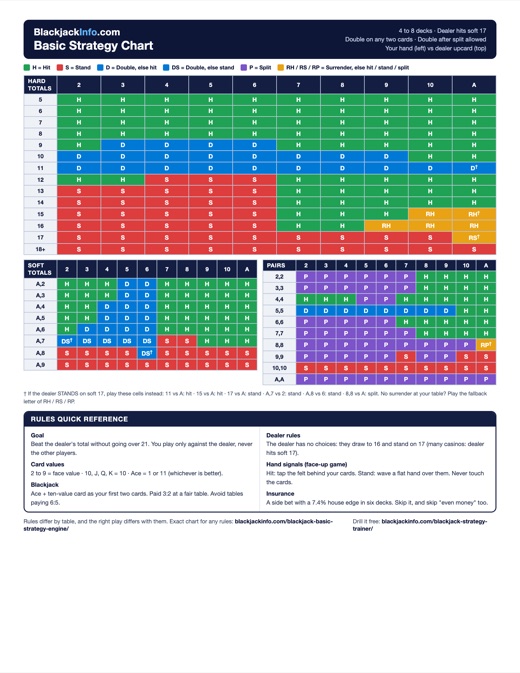
Free printable: rules + basic strategy chart
One page, ready to print: the full color-coded strategy chart for 4 to 8 deck games, with the rules quick reference on the same sheet. No email address, no signup.
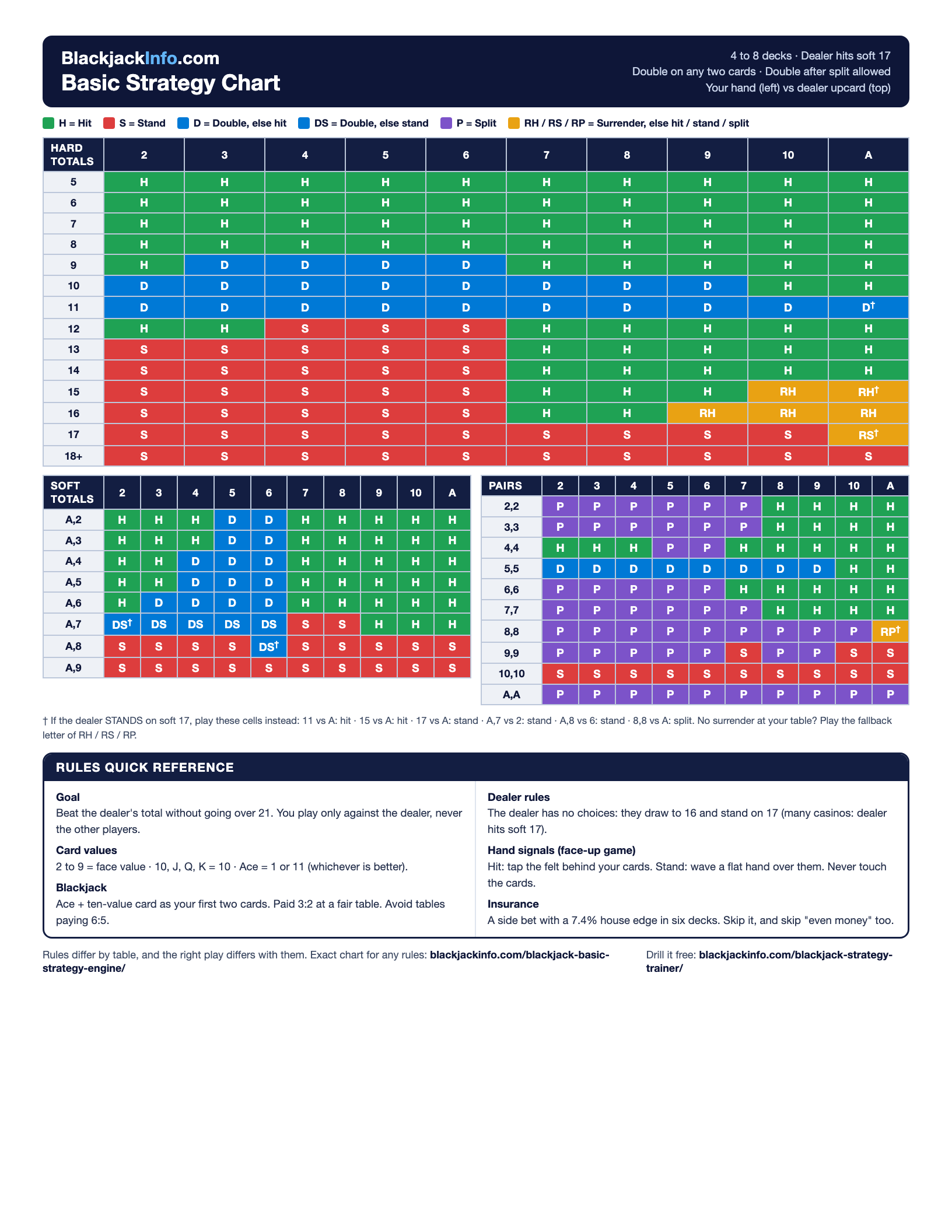
Chart assumes the dealer hits soft 17; the six cells that change under "stands on all 17s" are footnoted on the sheet. Prefer a plastic card for the table? We sell those too.
One chart cannot cover every casino, because the rules vary and the correct play varies with them. Our Blackjack Basic Strategy Engine generates the exact chart for any set of rules: tell it your table's decks, soft-17 rule and doubling rules, and it does the rest.
Reading a chart and playing it under casino lights are different skills. The free Blackjack Strategy Trainer deals you hands and corrects your mistakes as you play, which is by far the fastest way to make basic strategy automatic before real money is on the table.
Rule variations, and what each one costs you
Blackjack is not one game. A handful of rules vary from casino to casino, and even from table to table on the same floor, and they change how much of an edge the house holds over a basic strategy player. The differences are printed on the felt or on the table placard, so you can read a table before you sit down. Here is what each common variation does to the house edge in a six-deck game:
| Rule on the placard | House edge | What it means for you |
|---|---|---|
| "Blackjack pays 6 to 5" | +1.36% | The most expensive common rule, worse than every other bad rule combined. Just say no and find a 3:2 table. |
| "Dealer hits soft 17" (H17) | +0.22% | Letting the dealer improve a weak 17 makes the game tougher. Prefer "Dealer stands on all 17s" (S17) tables when you can find them. The S is for Stand, not Soft! |
| Double 10 and 11 only | +0.18% | An old Reno-style restriction. Doubling 9 and soft hands is part of your edge; restricting doubles to 9 through 11 still costs +0.09%. |
| No double after split | +0.12% | Doubling after a split (DAS) is standard in most of the US. Its absence is a real cost, not a detail. |
| No hole card (common in Europe) | +0.11% | The dealer takes their second card after you play, so a dealer blackjack can sweep split and double bets too. Strategy changes: in these games, don't split or double against a dealer ten or Ace (except splitting Aces against a ten). Use the "no peek" option in the Strategy Engine. |
| Late surrender offered | -0.08% | A small help, if you use it correctly and sparingly. Usually unposted; ask the dealer. |
| Resplit Aces allowed | -0.08% | Rarely posted; ask. Most casinos give split Aces one card each and no second chance. |
Deck count matters too. With the same rules, fewer decks mean a lower house edge for a basic strategy player:
| Decks | 1 | 2 | 4 | 6 | 8 |
|---|---|---|---|---|---|
| House edge | -0.15% | +0.20% | +0.38% | +0.44% | +0.47% |
The single-deck trap: that tempting -0.15% assumes the single-deck game still pays 3:2 on blackjack. Almost every single-deck game in a modern casino pays 6:5 instead, which turns the best game in the house into one of the worst. Check the felt before you sit.
The rules stack. A six-deck table with S17 and late surrender holds about 0.36% over a basic strategy player. The 6:5, H17, no-DAS table by the casino entrance holds about 2.1%: six times as expensive, for the same game at the same betting minimum. Thirty seconds of reading the placard is the best-paid work you will do in a casino. (Edges above assume six decks, double any two cards, double after split, dealer peek; against basic strategy.)
Insurance and "even money"
When the dealer's upcard is an Ace, they will offer "insurance": a side bet of up to half your original bet, paying 2:1 if the dealer's hole card is a ten-value card. Naming this side bet "insurance" was a brilliant marketing ploy, and otherwise solid players make this bad bet frequently to "protect" a good hand.
The math is short. For insurance to break even, the hole card would need to be a ten 1 time in 3. In a six-deck game, 96 of the 311 unseen cards are tens: about 1 in 3.24. That gap gives the house a 7.4% edge on the insurance bet (5.9% in single deck). Whether your own hand is good or bad changes nothing about that arithmetic.
If you have a blackjack and the dealer shows an Ace, you will be offered "even money": an immediate 1:1 payout instead of risking a push. It feels like a free win, but even money is nothing more than an insurance bet in disguise, and the same arithmetic applies: over time you collect more by declining and taking your 3:2 when the dealer does not have blackjack.
Unless you count cards and know the deck is rich in tens, never take insurance, and never take even money. Card counters can genuinely beat this bet; our card counting guide explains how.
At the casino: tables, chips and etiquette
Choosing a table
- Check the sign for betting limits. Minimum and maximum bets are posted at every table; find one that suits your bankroll.
- Look for "Blackjack pays 3 to 2" on the felt. Avoid any table that says 6:5, and make sure it is actually blackjack rather than one of the many lookalike table games.
- Beginners should start at shoe games. With every card face up, the dealer and other players can easily help you with decisions while you learn.
Buying chips
Wait for a break between hands and lay your cash on the felt in front of you. Don't try to hand money to the dealer: for security reasons they cannot take anything from your hands. And don't put cash in the betting circle, where some casinos will read it as a bet. The dealer exchanges the full amount for chips and drops the cash in a box; common chip colors are red for $5, green for $25 and black for $100.
Betting and getting paid
Push your bet into the betting circle as one stack, larger-value chips on the bottom. Once the cards are dealt, the chips in the circle are off limits until the hand is settled; if you need to know how much you have bet, the dealer will count it down for you. After the dealer pays you, you can pull your chips back, press them up, or leave a new bet for the next hand.
Leaving the table
The dealer cannot exchange chips for cash: that happens at the casino cashier. Before you go, tell the dealer you want to "color up", and they will trade your stack of small chips for fewer, larger ones that are easier to carry.
The five most common beginner mistakes
- Sitting at a 6:5 table. The costliest mistake on this page, made before the first card is dealt.
- Taking insurance or even money. A 7.4% house edge dressed up as protection.
- Splitting tens. A made 20 earns more than two hopeful tens ever will.
- Doubling for less. If the double is right, it is right for the full amount.
- Playing hunches instead of the chart. Basic strategy exists because someone already did the math on every hand you will ever hold. Drill it free until it is automatic.
FAQ
Do the suits of the cards make a difference?
Not at all. Unlike other card games, suits do not factor in at all in evaluating the cards.
What happens if my hand ties the dealer's hand?
A tie is called a "push", and you neither win nor lose your bet. Your chips stay in the betting circle, and you can leave them for the next hand, add to them, or take them back.
Do other players' decisions hurt my odds?
No. Your hand competes only against the dealer's hand, so another player's bad play does not change your long-run odds. Feel free to pick a seat you like and ignore how the rest of the table plays.
What is a soft hand?
A soft hand is any hand where an Ace can count as 11 without going over 21, such as Ace-6 (a soft 17). It cannot bust with one more card, which is why the correct play for soft hands is often more aggressive.
How much money should I bring to the table?
Buy in for at least enough to play several hands. A typical guideline is eight to ten times your bet size, so a $5 player might buy in for $40 or $50. Both the minimum and maximum bet are posted on a sign at the table.
Is 6:5 blackjack really that bad?
Yes. Getting paid 6:5 instead of 3:2 on blackjack adds about 1.4% to the house edge, which costs you more than every other common bad rule combined. Look for the phrase "Blackjack pays 3 to 2" on the felt before you sit down.
Why is insurance a bad bet?
Insurance pays 2:1, but the chance the dealer has a ten-value card under an Ace is worse than 1 in 3, so the bet loses money over time: the house edge is about 7.4% in a six-deck game. Unless you count cards, skip it, and skip "even money" too.
Is counting cards legal?
Yes! Read our article on card counting for more information
What's next: practice for free
You now know what to expect when you sit down at a blackjack table. Knowing the rules and playing them well are different things, and this is where BlackjackInfo differs from a rules page you skim and forget: everything you just read can be practiced here, free, before a casino sees your money.
Ready to go deeper? The free GameMaster's Blackjack School takes you from basic strategy through card counting in 24 lessons. And when you want to play from home, our online blackjack and live dealer blackjack guides cover how the game changes on a screen.
You're well on your way.

Ken Smith
Founder of BlackjackInfo.com and lifelong advantage player
Ken founded BlackjackInfo in 1998 and built it into one of the most trusted blackjack resources on the web. A professional tournament player with thousands of events behind him, he appeared in every broadcast season of GSN’s World Series of Blackjack and has taught players to count and play with an edge for over 25 years.
- Won the premiere event of the Ultimate Blackjack Tour on CBS in 2006
- Author of the two-volume “How to Win More Blackjack Tournaments” series and columns in Blackjack Confidential and All In Blackjack
- Publisher of the plastic basic strategy cards (2008) and the Advanced Strategy set with card counting indexes (2013)
tell me,please,how many boxes to bet when playing blackjack?
Hi, Im new at this game and not sure which basic strategy chart to memorize. I’ll be playing in Wendover. They have single ,double ,and 6 deck games. What would you suggest as a beginner?
Start with the 6 deck strategy, with dealer hits soft 17.
Ok. Thank you. I was trying to learn all 3 and getting confused so thank you
Hmmm seems I have been making some bad calls for years now, I thought splitting tens against anything but an ace or 10 was a good move :/
Thanks for setting me straight!
I’ve been a bit nervous about going to the casino and getting the hand signals wrong so thanks for clearing that up. Great article btw
what does the red light on the black jack table mean?
What red light are you referring to?
Is a Black Jack and a red Queen a Blackjack?
No , because blackjack and red queen are both 10 valued summing upto 20 only.
is card counting legal?
Of course, yes.
If a player decides to stand on 15 for whatever reason and the dealer has 16, must the dealer still draw another card since it is less than 17?
Yes
i was playing black jack at the casino in sudbury. when splitting two face cards the machine aloud me to play each card seperatly like two seperate hands but when splitting two aces the machine gave me one card on each ace and then played its hand not allowing me to play the aces at all . is this a common practice.
Yes, you can normally only get one additional card for each hand when you split aces.
If dealer has black jack and says they don’t and game continues and you get 21 as well what is the recourse.
I think you would lose
Ken Smith. Is there any significance in blackjack when you have a black jack paired with a black ace, same suit? The question came up on the multiple choice question on Millionaire. ” With 8 decks in the shoe, how many black jacks are there? I guessed 16 but the answer was 32???
No significance.
A blackjack appears on average about once every 21 hands.
4×8=32
thats because they meant how many possible black jack hands not “black” jacks
In playing 21 with one deck off cards aND two people playing, in playing Blackjack with one deck of cards and two people playing what is the most black jack show up
Don’t think it matters how many people are playing if its just 1 deck then blackjack could only appear 4 times, once for each Ace in the deck.
In one deck off cards with two people playing, what is really most a black show up.?
Blackjacks show up about once every 21 hands.
Not in Oz
Ken,
This may not be the most appropriate page to post this, but let me explain the situation. I aspire to hopefully gather a group of trustworthy guys together to form a blackjack team. unless I overlooked it, I don’t see anything anywhere on this website that discusses team play. It will be quite some time before I can actually execute this plan, but I have numerous details already worked out in my head and I’d like to run them by a pro to get some tips and advice.i have read several articles online discussing team play, but are there any resources or references you can give me about? And if you are willing and/or have time if I could somehow discuss some of my specific ideas with you? Just knowing of a good source either online or a good book I could get my hands on would suffice. Thank you.
Team play is complicated and far more involved than a group of friends pooling resources. There is not much published on team play. The following book may be helpful.
https://www.lasvegasadvisor.com/shop/products/blackjack-blueprint/
Ive always wondered and it is the way to go.
In a basic blackjack, does triple 7 suited be paid 3xs?
Not unless the casino has a special promotion.
How does it affect the game if the player can only split once , not multiple times?
The strategy does not change, but the player is worse off by around 0.1% if you are not allowed to resplit.
Say I’m the dealer and I have two players, the player on the left has 18 and stays and the other player on the right hits 21. As the dealer I get up to 20. Can the dealer chose to stay and take the chips bet from player on the left. But pay the player on the right?
The dealer cannot CHOOSE to do anything. His rules are fixed. He must hit until he has 17 or higher, and then he must stand. Even if all the players at the table have 18, the dealer must stand if he ends up with a 17.
One complication: Most casinos now deal games with an extra rule about soft 17. In the “Dealer Hits Soft 17” games, if the dealer has a hand like (Ace,3,3), that’s a “soft” 17, and he must hit again. This is covered in detail in the article above.
In your particular example, the dealer of course must stand with a total of 20, and he will collect the chips from the player with 18, and pay the player with 21.
I have a question. I’m just a beginner player but is 8 the maximum number of decks that are allowed to be used in a game of original blackjack? I signed up on an online casino and I was getting ready to play blackjack for real money and I asked the live chat help person how many decks were being used and she said 24 decks. Is that allowed?
Casinos, both online and land-based, can deal the game pretty much any way they like, including increasing the number of decks to a ridiculous 24! Fortunately, once you get to 8 decks, the game does not get much worse for the player by adding even more decks. In fact, there have been online casinos that dealt from “infinite” decks, which simply means that the probability of each rank of card being dealt is always 1 in 13.
For a basic strategy player, it doesn’t affect the game much going from 8 decks to 24 decks, or even infinite decks. Use the 8-deck strategy for these games.
Eight decks is the most typically seen in brick-and-mortar casinos, but in most jurisdictions, land-based or online, there is no legal requirement for any specific number of decks.
Is there any standard in the way a dealer deals from the deck? I know that casino’s use multiple decks and deal from them till they run out. However, as of late I’ve noticed that they are taking the cards and putting them in a shuffling machine after every hand so you cant see how many cards are left until the end of the decks is reached. I don’t actually count cards but I get an idea on whats is going on by watching what was played and what is left to be dealt. Is this allowed? As I just asked this question I suppose that its whatever the casino wants to do, Isn’t there some guidelines that they have to follow.
You are describing a CSM (continuous shuffle machine), where after each hand the dealer immediately puts the used cards back into the shuffler. As you note, this eliminates the ability to count cards, or to even observe a useful bias. Since used cards can return into play immediately, the penetration is effectively zero. These machines have spread widely. The only recourse is to see if your casino also still offers regular games (either hand-shuffled, or machine-shuffled but with a normal discard tray). If not, voice your discontent and look elsewhere.
also, I’ve tried to write a casino a couple times to find out their particular blackjack rules. No response. Should I be able to ask a casino to provide a copy of their rules?
I assume you are talking about online casinos. I would recommend avoiding any place that doesn’t have the rules clearly available on their site. Certainly, if they don’t respond to requests for the rules, that’s all I would need to know about their level of support. No way!