Card Counting Trainer
Practice the Hi-Lo card counting system on a real shoe, with checks on your running and true count before the deal.


Found a bug or have an idea? Leave a comment.
How The Counting Trainer Works
Play each hand the way you normally would. Your basic strategy is graded on every decision, exactly as on the blackjack strategy trainer, while the counting tools test the count itself. The shoe holds six decks unless you change it in Settings, and it reshuffles when the cut card comes out with about a quarter of the shoe left, so you never count cards a real game would not deal.
The counting tools are switched on in Settings: count checks, index plays and a bet ramp. The discard tray sits at the top left of the felt and the shoe at the top right. On a laptop, gives the table the whole screen.

Learn The Count, One Lesson At A Time
Open (top right of the game) and the course runs on past basic strategy into two counting units. Keep the count covers the running count, count checks and the tray, the true count and decks left, and what to do if you lose the count. Use the count covers index plays, bet ramps and the bet coach, swings and your bankroll, and reading your Stats.
Each lesson takes two or three minutes, and most put you straight back at the table to practice it. Check yourself deals 10 count checks, and 9 exact marks the unit done.
Count Checks Before The Deal
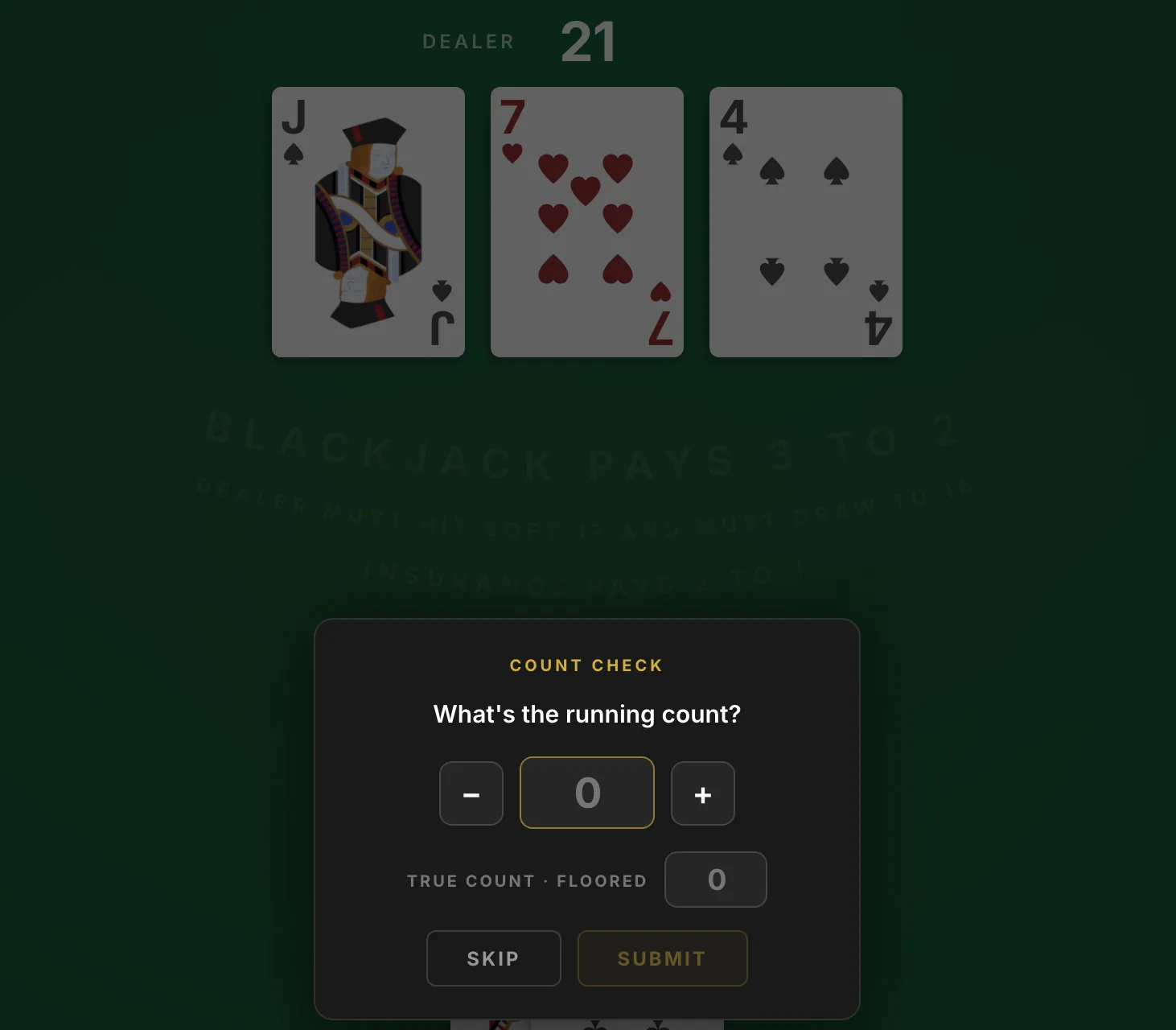
Switch on Count checks in Settings and the trainer stops before a deal, the moment a counter actually uses the count, and asks for your running count and your true count. Choose Frequent for a check about every three hands or Occasional for about every five; the exact gap varies so you cannot see it coming.
Answer and the trainer shows the right figures and replays every card dealt since your last check, so you can see exactly where you slipped. The true count is floored: rounded down, not toward zero.
Judge The Decks Left From The Tray
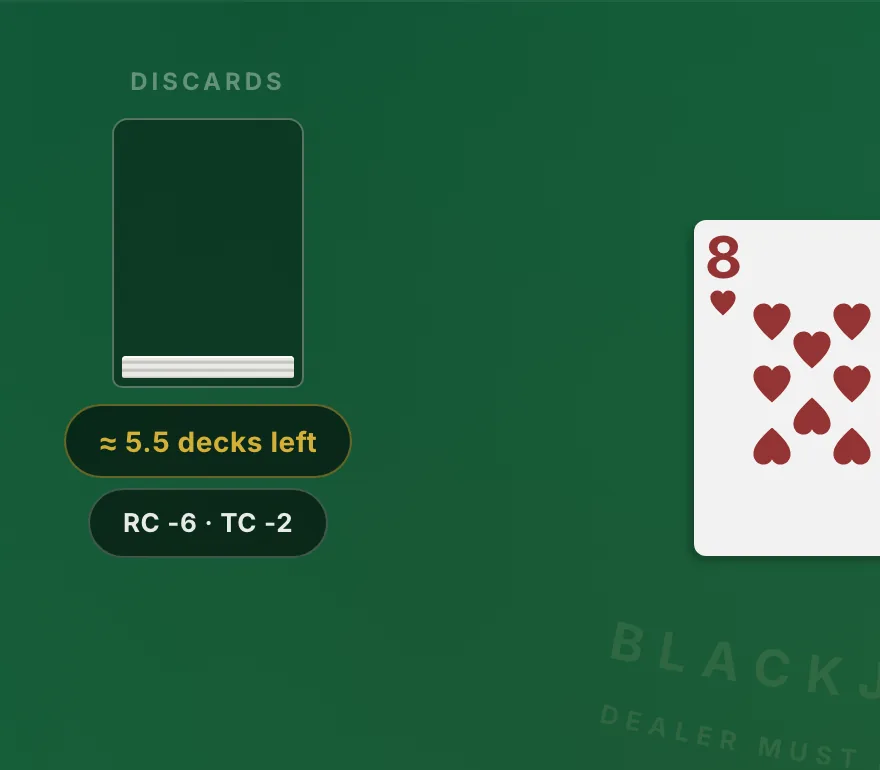
The discard tray stands on the felt and fills as hands are cleared away, so you can estimate the decks still to come the way a counter does at a real table, then divide. Click the tray to check your estimate: it shows about how many decks are left, with the running and true count beside it.
Index Plays And The Bet Coach
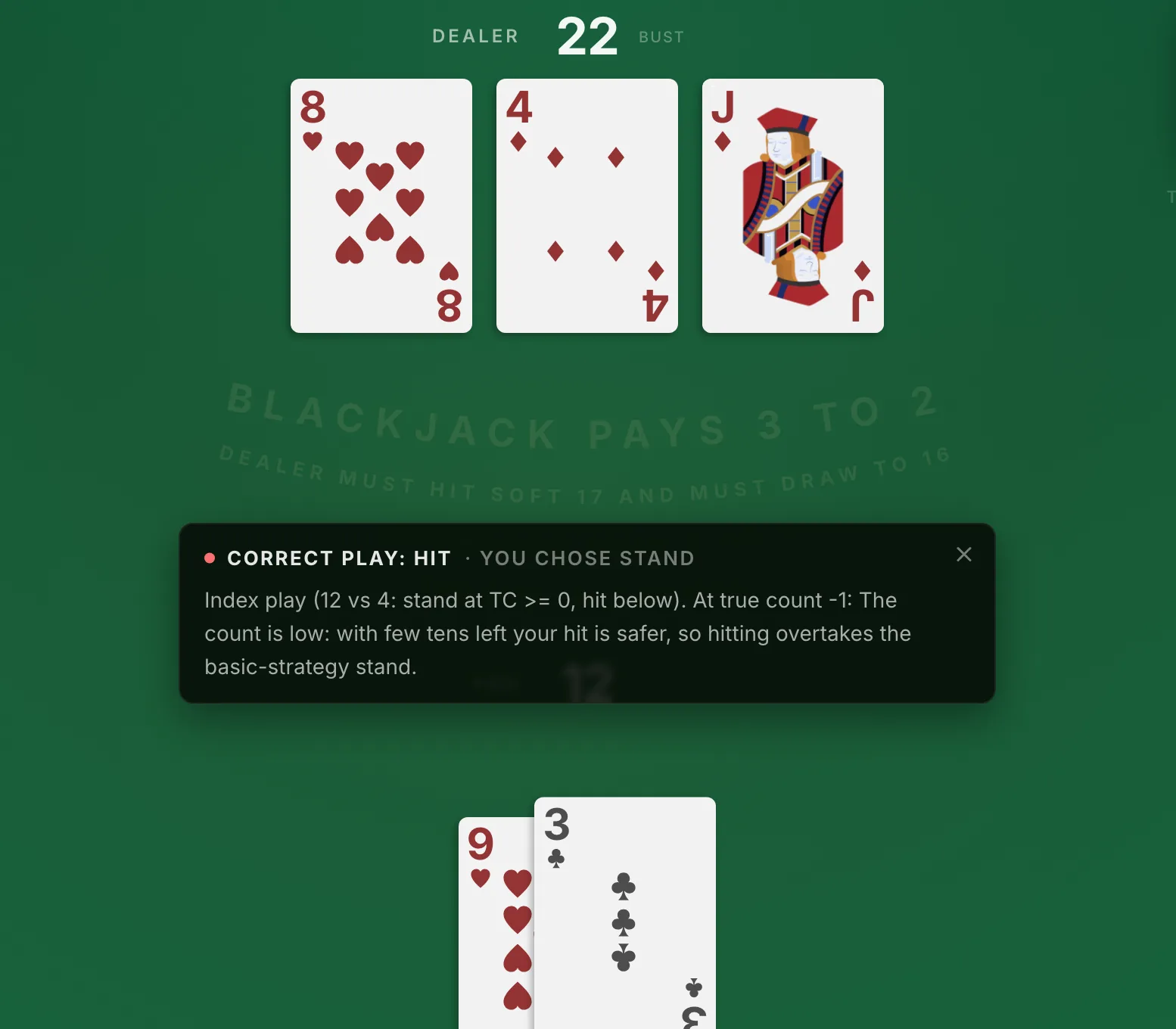
Switch on Index plays and the trainer grades the Illustrious 18 at the true count, plus the Fab 4 surrenders when late surrender is on. With the coach on, a missed index play names the index and explains why the count changed the play. The full list of indexes is in the strategy chart.
Switch on a Bet ramp, the units you bet at each true count, and start from Conservative (1 to 4 units), Standard (1 to 8) or Aggressive (1 to 12), or set your own. The bet coach can show the bet your ramp calls for before each deal, or flag a bet that strays from it afterwards.
Stats then adds Count, Index and Bets tabs that grade your count checks, your index plays and your bets.
Running count versus true count
The trainer uses Hi-Lo, the most common balanced system. Every card carries a value: 2 through 6 count as +1, 7 through 9 count as 0, and every 10, face card and Ace counts as -1. Add those values as the cards appear and you have the running count. Because the +1s and -1s are balanced across a full deck, a shoe that has been dealt fairly sits near zero; a positive count means the low cards are gone and the high cards that favour the player still remain.
The running count on its own is not enough, because +6 with one deck left is far stronger than +6 with five decks left. Convert it to the true count by dividing the running count by the number of decks still to be dealt. The true count is what drives every decision: how much to bet, when to take insurance, and which basic strategy plays to deviate from. If the conversion is new to you, work through the hub guide on how to count cards first, then come back here to drill it under time pressure.
How to practice effectively
Build the skill in layers, the way the Learn course does. Start with the running count alone, with Count checks set to Frequent so a mistake never has time to compound. When a check catches you out, go through the cards it replays and find the one you missed. Once the running count is always exact, add the true count: look at the discard tray, estimate the decks left, divide, then click the tray to see how close you were. A realistic bar is a running count that is always exact and a true count within one of the trainer’s answer, because a single miscount can flip a betting or insurance decision the wrong way. Then move to Occasional checks, so you hold the count for longer between them. Accuracy matters far more than speed while you are building the habit.
Do not let your basic strategy slip while you count. The trainer grades every play as well as every count, which catches the common trap of nailing the count while quietly misplaying hands, and that gives back more than the count earns. Once the count is solid, switch on index plays and rehearse the deviations that actually change with the true count. The Illustrious 18 and Fab 4 chart lists every index, and the Illustrious 18 drill deals them one spot at a time. Last, add a bet ramp and let the bet coach check that your bets follow the count.
Honest expectations
Counting works, but the edge is small. At the trainer’s default table, with every count and every play right and the Standard 1 to 8 ramp on a $10 unit, a counter earns about 0.4% of the money bet, roughly $8 per 100 hands. That figure is a long-term average buried under heavy short-term swings: you can lose many counting sessions in a row even when your play is flawless, and even a bankroll of 800 units is lost about one time in five over 100,000 hands with that ramp. Counting rewards patience and an adequate bankroll, not a single lucky night, and a trainer costs nothing when the cards run against you, so it is easy to overrate how smooth the real thing feels.
Casinos also push back. They shuffle earlier to cut penetration, deal from continuous shuffling machines that make counting pointless, watch for bet spreads that jump with the count, and are free to ask a suspected counter to leave. None of that appears in a trainer, where the shoe is honest and nobody is watching. Treat this page for exactly what it is: a place to make the count and the deviations second nature, so that if you ever sit at a real table the arithmetic is the easy part. It is a practice tool, not a money printer.
Keep Your Basic Strategy Sharp
Counting only pays when every hand is played right, because a misplayed hand gives back more than the count earns. If you still reach for the chart, spend time on the blackjack strategy trainer first, or drill one kind of hand at a time in the Drill Library.
Open the Blackjack Strategy Trainer Browse the drills
Basic Strategy On Your Phone
The free Blackjack Strategy Trainer app for iPhone, iPad and Android teaches basic strategy only, with no card counting. Use it to keep your plays sharp away from a computer, and come back here to practice the count.


What’s New
Every update, newest first
1 October 2026
- Learn the count. Two new units in Learn. Keep the count covers the running count, count checks and the tray, the true count and decks left, and losing the count. Use the count covers index plays, bet ramps and the bet coach, swings and your bankroll, and reading your Stats.
- Count checks. The trainer stops before a deal and asks for your running count and true count, then replays the cards dealt since your last check. They replace the old Show Count and Go Blind panel.
- Discard tray. Click the tray on the felt for the decks left with the running and true count, the way a counter judges the shoe at a real table.
- Index plays and bet coach. The Illustrious 18, plus the Fab 4 surrenders when late surrender is on, graded at the true count; and Conservative, Standard and Aggressive bet ramps with a bet coach.
- Stats. Count, Index and Bets tabs grade your count checks, your index plays and your bets.
6 September 2026
- Clearer cards. The cards have been redrawn with larger corner indices, so you can read rank and suit at a glance while you keep the count.
- Tidier counting layout. The controls and result panel now sit inside the felt, keeping the counting panel beside the table where you can see it.
- Better on phones. On narrow screens the action buttons sit on a single row and the table fills the viewport.

BlackjackInfo.com administrator
Tum administers BlackjackInfo.com and moderates its forum, and has worked across the LCB network of casino, poker and sports affiliate sites for more than ten years.

Advantage player and longtime BlackjackInfo forum administrator
LV Bear has played advantage blackjack for decades and helps run the BlackjackInfo community, where he moderates the advantage-play and game-protection discussions. He reviewed this article for accuracy on the mechanics of counting, casino countermeasures, and the realistic economics of playing with an edge.
- Decades of hands-on advantage play across shoe and single-deck games
- Administrator and moderator of the BlackjackInfo advantage-play forums
This site is protected by reCAPTCHA and the Google Privacy Policy and Terms of Service apply.