Blackjack Basic Strategy Engine FAQ
Q1: What is Basic Strategy?
Q2: Why do blackjack books seem to disagree on basic strategy?
Q3: What do all these rule questions and abbreviations mean?
Q4: How do I use the charts?
Q5: Can a player make money in the long run by playing Basic Strategy?
Q6: Is there any strategy that yields a long-term advantage for the player?
Q7: How did you arrive at the charts that the Engine provides?
Q8: Could you provide the Basic Strategy Edge for the game along with the optimal strategy chart?
Q9: What about the European No-Hole-Card rule?
Q10: Why are you doing this?
Send comments via
.
Home |
Strategy Engine |
Blackjack Rules |
FAQ |
Tournaments |
Play the Game |
Books |
Links
Q1: What is Basic Strategy?
This definition is from Peter Griffin's The Theory of Blackjack:
The basic strategy is the strategy which maximizes the player's
average gain, or expectation, playing one hand against a complete pack
of cards.
The basic strategy, then constitutes a complete set of decision rules
covering all possible choices the player may encounter, but without
reference to any other player's cards or any cards used on a previous
round before the deck is reshuffled.
Q2: Why do blackjack books seem to disagree on basic strategy?
The correct basic strategy depends on the exact details of the game to which
it applies. The number of decks, and the various rule changes from casino to
casino make a difference in the correct strategy. Most authors when writing
about blackjack have chosen to describe a basic strategy which applies to
the most common games, often without explaining for which exact game their
charts are intended. Some authors explain which game their charts assume,
but this may be a different game than other authors chose. And, unfortunately,
some author's charts are simply incorrect for any game.
Q3: What do all these rule questions and abbreviations mean?
- Number of decks:
- Pretty self-explanatory.
- Dealer hits or stands on Soft 17:
- The table layout in most casinos will indicate whether the dealer stands
on all 17s, or must hit soft 17 but stand on hard 17 or better. The casino
has a larger advantage (by about 0.2%) in games where the dealer hits soft 17.
(A soft 17 is a hand which includes an Ace and can be counted as 7 or 17.
Example: (Ace,6) is a soft 17. (Ace,6,Ten) is a hard 17 since now the Ace must
be counted as a one.)
(H17=Hit Soft 17; S17=Stand on all 17s)
- Doubling allowed:
- Some casinos restrict the player from doubling down, by only allowing doubling
when the player has a total of 10 or 11, while some casinos allow doubling
of any two-card hand.
(DA2=Double any two-card hand; D9=Double 9,10,11 only;
D10=Double 10,11 only)
- Double after Split:
- Some casinos have a favorable rule allowing players to double down
on a two-card hand that results after splitting a pair.
(DAS=Yes; No DAS=No)
- Surrender:
- Surrender, when available, allows a player to fold a hand by giving up
half the original bet. The two varieties of surrender are described as
early or late, depending on whether they are permitted before
or after the dealer checks for blackjack. Early surrender, which allows the
player to fold for half the bet even if the dealer turns out to have blackjack,
is quite rare, and quite advantageous to the player. The more common, but
still not widespread, type of surrender is late surrender, available only
after the dealer is known to not have blackjack.
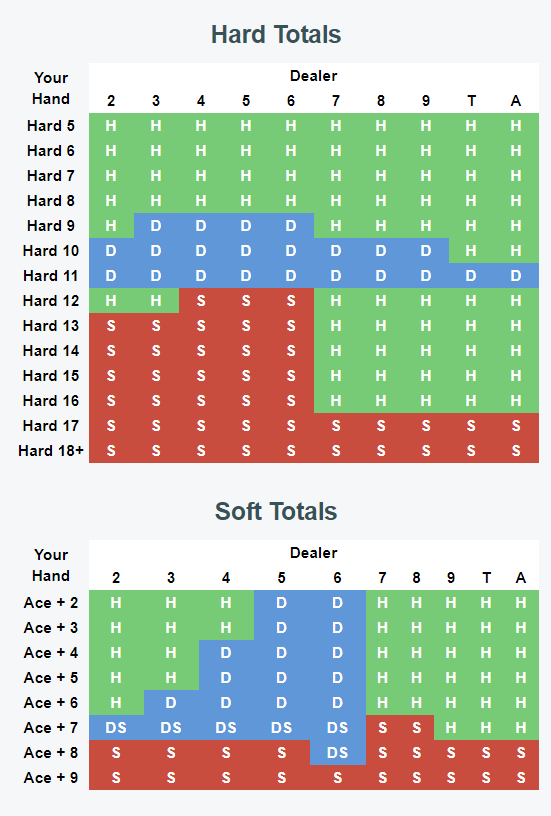
Q4: How do I use the charts?
After submitting your choices for various rules, you'll get a color-coded
strategy chart tailored to the exact game in which you are interested.
Each possible decision that you might encounter can be found by looking up the
dealer's upcard across the top, and your hand total on the side. If your hand
is a pair, you should check the pair-splitting chart first, then refer to
either the Hard Totals or Soft Totals page of the chart as appropriate.
(A Soft total is a hand where one of your cards is an Ace, and may be counted
as either one or eleven. So, (Ace,6) is a soft 17, but (Ace,6,Ten) is a
hard 17.) The chart will indicate whether you should Surrender, Double Down, Hit,
or Stand.
Q5: Can a player make money in the long run by playing Basic Strategy?
In almost all cases, no.
Playing basic strategy in most games will reduce the house advantage against
the player to 0.5% or less. Many of the better games available in the US have
a basic strategy house advantage of around 0.2%. And, in rare cases, some
casinos do offer a game in which the basic strategy player does have an
advantage. For example, several casinos in Colorado now offer single deck
games with favorable rules that give the basic strategy player a small but
real long-term edge against the house. Unfortunately, these casinos also
have a maximum bet of $5 per hand, which reduces the value of the player's
edge to only a few cents an hour playing perfectly.
Q6: Is there any strategy that yields a long-term advantage for the player?
Yes, a player who can accumulate information about the cards that have
been seen, and use that information to vary his bets and the play of his
subsequent hands can derive a small but real advantage over the game.
Discussion of card-counting is beyond the scope of this FAQ. A good starting
spot would be the
rec.gambling.blackjack FAQ.
Q7: How did you arrive at the charts that the Engine provides?
All of the strategies provided by the Engine are based on combinatorial
analysis, not the results of simulations. The process of determining an
exact strategy is very computation-intensive. It was assumed that pairs could
be split up to 4 hands, and the already-computed basic strategy was used for
split hands. The only exception to this method is for surrender strategy.
I added surrender to the Engine only after doing most of the work, and
therefore simply used existing references for the appropriate strategies. The
surrender plays indicated are therefore not varied based on rules or number
of decks. Somewhat ironic, since surrender is the easiest calculation to
make from a computational standpoint.
Q8: Could you provide the Basic Strategy Edge for the game along with
the optimal strategy chart?
Well, it's finally done, although the house edge is an estimate. I'm still planning
to rework the entire engine, and provide absolutely accurate advantage numbers for
each possible set of rules.
Q9: What about the European No-Hole-Card rule?
Some casinos in Europe do not deal the dealer's second card until each
player at the table has finished his hand. Then, if the dealer makes a
Blackjack, the entire player's bet, including double-downs and splits is
lost. For these casinos, the charts provided here are inaccurate against
a dealer upcard of 10 or Ace. In this case, you should split Ace-Ace
against a 10, but otherwise do not double or split against a dealer upcard
of 10 or Ace.
Note that some US casinos also do not deal the dealer's second card until
after each player's hand is complete. However, to my knowledge, none of these
casinos will collect more than the original bet in the event of a dealer
blackjack. In this case, there is no difference in the strategy.
Q10: Why are you doing this?
Well, I wanted to learn a little about CGI and HTML, so I thought that this
would be a fun project. It turned out to be quite popular, so now the site
is supported by advertising sponsors.
But the real reason I'm doing this is I figure it's a nice free service that
somebody needed to provide on the Web. Enjoy!
Home |
Strategy Engine |
Blackjack Rules |
FAQ |
Tournaments |
Play the Game |
Books |
Links
Send comments, praise, and criticism to:
Copyright © 1996-2004 by Bayview Strategies and Kenneth R Smith. This page and all
other pages at this site are protected by copyright.
Use of text, images, layout, format, look, or feel of these pages, without the written
permission of the copyright holder is strictly prohibited. All Rights Reserved.